Showing posts with label relationships. Show all posts

Sunday, 13 September 2015

"I turn a lot of heads, I turn a lot of stomachs" what it's like when you're not the object of desire

A friend on Facebook posted this article by Sarah Einstein and my response to it feels bigger than I could reasonably call 'a status'. In the article Einstein talks about her experience of being an older, less physically attractive wife to a younger, more physically attractive man. The two speak freely about their situation- he is not attracted to her body and she is working through her negative feelings about this. He is however attracted to her mind and she feels good about this. 


Like Sarah Einstein '(...)beautiful has always been beyond me. If people find me so, it’s only after they’ve come to know me. (...) I minded this quite a lot in my teens, when it seemed that only beautiful people mattered, that it was a prerequisite for a good life.' But more than her writing about how she doesn't turn heads or has always been plain, I find I turn plenty of heads. I have always repulsed people (especially men) and can't walk down a street without an extended look. Hardly go a day without comments being made  about me. On my first day of my current job my boss gave me diet advice. I get comments about my unattractiveness online a lot (A LOT). And why is this? Well, it's not because I'm plain, I wish I was plain! Plain would be a godsend.


 By conventional standards I am deeply ugly (in part due to my being a fat person, in part a hairy mixed white/arab woman, I have a heavy brow, a giant chin and a strangely cartoonish look). I also have large disfigurements on my body. I can say these things. I can say them and know that they are true to society's standards but not absolute fact. I spent many years feeling like it wasn't my job to be beautiful, I rebelled against beauty, wore sexy clothes on Wednesday mornings without waxing my eyebrows. I took a few years out to readjust what I expected of my body and myself. 


Somewhere down the line I began to feel my subversion of norms was actually, very attractive. I am not easy on the eyes, my presence requires space and attention & work. It always has, but importantly I stopped trying to make myself smaller & I started occupying space in my own life.


When I was seventeen a (frankly mediocre) man once said to me 'I think about us being together. Usually I go for good looking women but you've got this intellect'. 
but you've got this intellect.
He's married now, to a beautiful woman, a friend actually. And I hope at least for her that he has let go of the abstract standard beauty he had decided it was his job to enforce on women. 

Though this statement stung (stings, even after eight years) I can see where he was coming from.I can see why she is his wife. I can see why I am not. I can see why Sarah Einstein is doing herself a favour by working through her feelings on her desirability.


I'm not Sarah Einstein. I'm a queer, fat, disabled and working class person. I'm also polyamorous. I work really hard to undo the messages society has taught me about myself (in the full knowledge that not everyone I sleep next to has bothered to do the same). I try my best to avoid toxic media messages, I look at myself naked in the mirror even on the days I don't want to. I read books written by other fat people. I shout at men who harass me in the street. I call out abusive behaviours in the queer scene (usually to my own exclusion and suffering). I take myself on decadent dates. I eat in public. I talk about sex. I care more about Janelle Monae than Jeremy Clarkson. I have several sexual and romantic partners. I cut toxic people out my life (where safe and possible to do so). I do most of my online interacting in explicitly queer femme spaces and the people whose opinions I listen to are mainly other fat working class femmes.


But something is rotten in the state of Denmark (my life). On a daily basis I feel my relationships (despite my attempts to work against it) have been/are still highly impacted by the thinking that my body is unsexy, undesirable and that my merit (smash merit tbh) is based purely in how much I can perform the role of funny fatty and clever prole.  I know lots of other people I know feel the same. And I want to tell you- it is not your job to fill in the deficit others consider your body to make with with, intellect or entertainment. Beautiful, thin, young people are allowed to be vapid & so are you.


The other day I was thinking about polyamory and the very real and harmful way in which people stack, hierachalise and demote their romantic/sexual partners. Polyamory is supposed to an alternate method of loving and dating to the typical white heterosexual nuclear family of Western economic creation. It's not a massive surprise that it ends up reinforcing a lot of the really shitty dynamics that already exist. I can't tell you how many times I found myself pushed out of relationships by people who were more conventionally attractive than me. You see in our relationships there's no need to break up, we can just invest more time in the people we think gain us more social capital. And slowly us uglies fade away.


And I'm sorry Sarah, but I'm just not as strong as you, I can't make peace with being the person who is the last resort date (or friend, femmerades, let's not pretend we aren't stuck doing the dishes whilst the cool andro and masculine people gain queer points by misquoting Marx). I can't make peace with my body being a barrier or a hurdle for people to love me. 


Me stating this doesn't mean it isn't something that effects me. If only acknowledging this shit meant it went away. I assure you, I'm well aware that all my relationships are subject to my partners not finding someone more attractive and thinner. And yeah, I spend a lot of my time stuck in scarcity mentality (warning on this link for discussion and take down of dieting).  Reading Einstein's article I felt deeply emotional at the passage 'In our early days, before my husband could articulate the ways in which he both did, and did not, feel desire for me, we sometimes fought about our sex life. I’m tired of always having to be the one who makes the first move, I’d say, and do you think I’m ugly, and of course are you sure you love me? (...) And we’d make love that night because he’d reach for me, and then not again—sometimes for weeks—until I reached for him.' because man, I know those feels. And it's not just about sex because as other people who are reminded daily by the behaviour of partners, friends and family- we all know that it's difficult to feel loved by someone who to all intents and purposes feeds our self-loathing. I feel like we (fat femmes, working class women) wake up every day and exist, fight through family meals and obnoxious men and horrible media messages about ourselves. We are strong. But your oppressive body politics are your issue and something you need to work through to be safe to date us. It's not about education it's about work. Your pseudo sex positive 'preferences' don't exist in an apolitical vacuum. 
 

A while back a friend who was having a difficult time read me this article by Derek Sivers entitled 'No more yes. It's either HELL YEAH! or no' (warning there for overly enthusiastic straight dude). We need to be 100% clear that being fat doesn't make you unsexy and being older doesn't make you undesirable and being attractive in a non-conventional manner isn't an excuse for a lack lustre approach to us or our bodies. Equally, the kyriarchal bullshit that slips out the mouths of your partners and family is no excuse for a half-arsed approach to loving yourself. It will hurt when the person you were filling in time for (shout out at this point to Samantha Peterson for writing this amazing poem) comes along and they are thinner, and funnier(although funnier is unlikely) than you. They are literally you lite. It will hurt and then it won't. It is not evidence. It does not confirm anything other than the person who pushed you aside is a grade A trumpet. You do not have to spend another moment being pushed aside or undesired. I could tell you that I will always find beauty in the piece of you that they recoiled from, and I will, but the most important thing is that we find ourselves worthy. Even when how we feel about ourselves is negated by someone we love. Sarah Einstein's article registered with me in several ways, and I know that what she is saying is important and true and sad and beautiful. But for me, it's not the end of the story. 

If nothing else- it is a lot of work to be the person holding up both (or all) sides of a relationship. Call me an entitled millenial (or whatever bullshit term people are using to describe young women who they disagree with these days) but I'm not willing to hedge my future happiness on an Ann Summer's catalogue & the hope that I find someone who tolerates my powerful, exciting body.


 You cannot validate yourself through other people. And if they leave you in the fruit bowl in hope of finding less bruised fruit, then- fuck them. Or rather, don't. They are not your safety.

Lately I have been writing things down to make sense of them, I have been reading more in order to improve my writing and in my reading I found these words. I repeat them to myself when ever I feel devalued by someone I love, or am invested in

'you can't make homes out of human beings
someone should have already told you that
and if he wants to leave
then let him leave
you are terrifying
and strange and beautiful 
something not everyone knows how to love.' 
-Warsan Shireh
For women who are difficult to love


Wednesday, 26 August 2015

This year my birthday present to me...IS ME

I know, I know, that sounds super cheesy and a bit hippie right? But there is definitive proof me and birthdays don’t get on well (*see at bottom of page for self pitying list) and I think I know why. It seems to me that birthdays are another front where my inability to surround myself with loving and respectful people, or (as suggested by my therapist) my inability to consider myself wholly worthy of (and demand) a decent level of respect sees me spending every August and most of September with a low sinking feeling in my stomach. The pressure is on to organise ‘A Thing’ or have ‘A Thing’ organised for me.

Suddenly Facebook events become a rite of passage for validation. Sentimental baby pictures taped up on lampposts are a necessity and ideally you have your own hash-tag. Because of this I am nervous. I am neurotic. I am 100% sure that everybody hates me and I am going to spend my birthday in another family's caravan, resented and alone. People like drinking, but I don't drink. Queers are supposed to be able to smoke weed and drink gin, but I have found myself deeply & unfashionably sober since the age of 21 (and constantly excluded for it). We're supposed to spend our birthdays being showered with gifts by our (presumably wealthy) families. But that's not really how stuff goes for me either. If nothing else we're supposed accept this yearly occurrence with grace and dignity. But I seem to be stuck with grace and dignity's working class cousins- money problems and anxiety. The resonating pressure of those two words 'supposed to' means that by early September I am a mess.I have only ever had one friend who seems to have the organisational skill and reckless determination to tackle me and my birthday phobia, who has listened to me cry from bed after being let down by friends, who has rang me up every year since I was 17 and said ‘So what are we doing for your birthday?', who made sure I was never forgotten never invisible on my birthday (it’s you, Lucy, in case you’re wondering) and whilst I truly love her for it, those aren’t very good odds are they? One person out of hundreds?

Don’t get me wrong when I say me and birthdays don’t get on. I mean there are good elements of all the birthdays listed below (I mean, who wants to speak to humans anyway, goats are way cooler) and I have had good birthdays. When I was little, birthdays were magical. I got to dress up in a BIG POOFY DRESS and wear a ribbon on my head. I got shiny toys and I got to see family. But most of all, the loving attention that was laid upon me made me feel replenished, special and capable. People being happy that you were born is like, a pretty nice indicator.But when you're not living the dream life (not even on instagram), when 'Suddenly I see' by KT Turnstall doesn't play as you walk down the street, when maybe not everyone is overly excited about the fact that you still exist, where does that attention come from?

I am a common, fat, womanish person with holes in my shoes and no postgraduate degree who doesn't take sh*t from people. Societal norms dictate that I am not first in line for loving attention. So what do I do? Well here comes the super cheesy idea- maybe I give myself that attention? (Not in that way, although maybe, I mean, self-love right?) Maybe you could give it to yourself too? After all, for those of us who are pushed out of spaces, spoken over in our social groups and sidelined at work is there really any other option?


Here is my action plan

1. Take it from Akua Naru “self love is the very first romance”
Everyday I am trying my best to remind myself that I am in a life long relationship with myself and that I am a gift that only improves with age. Every year I know more, try new things, meet new people, and achieve new things. Even if it’s getting out of bed, making it to work, writing this blog post. I am reminding myself that the aging process is not negative and that I am a worthy person all year round.

2. Forgiveness is a virtue
Forgiving myself for being imperfect in a world that demands an oppressive standard, forgiving myself for not doing enough work or forgetting to pick up milk. I am doing my best to look upon myself with forgiving eyes because like it or not, I am stuck with myself for the long haul. Forgiveness is difficult when you have no money and limited prospects. Forgiveness is difficult when you are unhappy with your place in the queerosphere, the workplace, the family and society. Forgiveness is a process, and it will probably take me the rest of my life, but guilt will ruin the rest of my life & I know which I'd rather be working towards.

3. Enjoying the ride
Everything I achieved I achieved in this body with this brain. When I am distracted by negative and toxic messages about my self worth I am being drained of my energy. Energy to be an attentive partner, energy to be a supportive colleague, energy to organise politically, energy to confront the trauma in my past. I have started looking at baby photos. I have started making lists of my adventures. I have started spending time with the old friends who I can laugh with at shared memories. But most of all I have started have started celebrating my life in its current state, no apologies. Being at war with myself is not sustainable. If I am working towards living & forgiving (as in points one and two) then this point to say that I must also work towards surviving and thriving. 
Me (far right) running whilst fat

This year I am my own birthday present. I am ensuring that I lavish myself with loving attention, that I feel replenished. This year I am fat, and worthy. Disabled and capable. Anxious and loud. Sober and entertaining. Ugly and beautiful. Serious and hilarious. Working class and yes, probably a little bit more intelligent than you.This year I am imperfect, my own little state of anarchy. It's not all planned out. I'm not looking forward to a holiday or a promotion, and it's highly likely that I'm not going to be 'achieving' things in the way that I'm 'supposed to'. But I'll make do with what I've got and what I've got has a lot of potential. This year I am wearing a BIG POOFY DRESS and a ribbon in my hair. And even if I spend the day on my own, or don't hear from family, or things don't go to plan, this day doesn't define me. It's not a test, not another chance to flaunt my social capital. It's enough to just get a year older and still be alive. I am taking responsibility for myself and that is scary, yeah. But god, the odds of getting through the month are so much better when I’m not at war with the person in the mirror.


*Self Pitying List 1. There was the year when I spent my birthday on a family trip in Wales with some family members, wandering lonely and only comforted by the presence of goats, stranded with a little family I wasn’t really a part of (seriously you wanna see the pictures from the disposable camera taken on that holiday, a picture of me with a dog, a picture of some rabbits, a picture of a pony, some more rabbits, the cloudy Welsh sky, a goat, two goats, three goats). 2. There was the year I spent my birthday in bed crying after being let down by a friend. 3. There was the year a parent forgot how old I was. 4. There was the year a family member forced me to have a ‘tea party’ against my will & when they then proceeded to get drunk and to flail around the house to a soundtrack of Bob Marley and my father saying (louder than he thought) ‘doesn’t she (me) have any friends?’. 5. There was the year I became '& co' at a joint party. 6. There was the year my foster mother forced me to spend my birthday watching her cry in a KFC car park, and gave me a box of chocolates & and old bottle of perfume in the gift bag I gave her some Mother’s Day presents in. Don’t get me wrong, it’s not about the money or the gifts, but she got a bloody grant on my birthday. 7. There was the year all my ‘friends’ at my primary school didn’t come to my birthday sleepover because I was the fat kid with a single mum and we lived in a council house. 8. There was the year when I had the flu & a family member organised a meal in the local Italian restaurant & shouted at me for not dressing up enough so I spent the day half crying. 9. There was the year when I threw myself a party, had a panic attack and thought I was dying. 10. There was the several years I lost out to aggressive, careless, cruel or controlling partners, illness, self loathing. 11. There was the many years where my birthday was just a way to keep the electricity meter going, just a token from people who offered no further support during the rest of the year.

Monday, 23 June 2014

Being a care leaver, being a survivor.


What does it mean to be a care leaver? 
In policy terms it means a relevant child or former relevant child who has been under the care of their local authority as a young person. For the purposes of our everyday lives I will discuss what being a care leaver means on a practical, emotional level and what it means within society. These discussions may not be confined or limited to purely legal definitions depicted in government policy.

The experience(s) of young people in care is one of the most important  measurements of society’s values.We need to talk about our experiences in care, because they shape who we are after care. We are taught how and where we fit into society whilst in care. But we also learn about how society functions in relation to us because being in care means you are very aware of how the state treats some of its most vulnerable citizens. The entire country’s ideas and values are built around the government and politics of the time (whether people agree or disagree with them is less important than the fact they exist.) And because so much of our interactions with the local government are taken up by initiatives and new schemes (does anyone remember free laptops?), we understand which parts of our lives society sees as important and which parts it chooses to forget or ignore.

 Abuse, representation and reality
For example of young people in care being yardsticks of values I will discuss a time paedophilia and child abuse were less discussed, engaged with and investigated. An instance of this is the widely discussed case of Jimmy Savile, whose celebrity status and power gained him entry to the homes and lives of vulnerable young people in care.  In the 2012 documentary produced by the BBC entitled ‘Jimmy Savile What the BBC knew’ the  investigators spoke with people who were in care and abused by (or witnessed abuse by) Savile.  Young women were often taken out in Savile’s car and didn’t realise that his actions were abuse, some even believed them to be romantic. In a lot of cases it seems safe to say that the lack education on relationships that these young women received contributed to them believing the interactions they had were healthy, and the abuse they endured was a ‘trade off’ for escape from their homes and for getting some attention that made them feel important. This, along with the workers in the homes being in awe of Savile, and the Police dismissing the young people's reports meant that many of these young people, now middle aged and older have never spoken about their experiences.

So celebrity culture, the police and the care system created a free pass for Savile to abuse young women. 

Obviously some things have changed now. There is policy in place by for both the police and local authorities that should prevent this situation from happening. It is worth noting that this policy is often overlooked, or ignored by the police in situations relating to rape. Sometimes those who work with care leavers and young people in care don't get given the practical skills to put the policy into practice. This isn't the fault of those people, but rather a result of policy being written with lots of jargon and little understanding of how we live our lives.  Thus we see that the power dynamics of young people in care (with little or no power and understanding of the love and care they're entitled to) and adults with power over young people means that abuse occurs often. And just as often is goes unrecognised. 

Most recently there was the representation of (again sexual) abuse in the  Channel 4 drama The Unloved, this time they showed a young women being abused by a member of staff. The media often uses young people in care as a story, they sensationalise our experiences and turn us into statistics to scare their readers, but the media is often silent on other forms of abuse and the rest of the difficulties that face young people in care and care leavers.

Why abuse. why now?
I’ve had many interactions with other care leavers, at special events, and just personal chats and what seems most common is the widespread experience of abuse, before, during and after they have been taken into and left care. Obviously sexual abuse is important, but I’d like to define a few other kinds and open discussion about one. Physical abuse is  violence and physical harm, neglect is failing to meet a persons care needs, emotional abuse is bullying a person verbally, psychological abuse is more commonly understood as ‘mind games’. Abusers can be people in authority or our peers, it can happen at any point and all abuse is wrong.

 Most of the people in care I have spoken to and all of the care leavers I have gotten to know (and myself) have experienced at least one of these forms of abuse, usually more. I’ve never attended an event for care leavers that didn't turn into those present talking about their horrible experiences. Drunken foster parents, possessions stolen, or kept, physical harm, blame, lies told to social workers. I think one of the most important things I can say is- I believe them all. Care leavers and young people in care are so often not believed, so often people tell us that we ‘must’ have done something to provoke abuse towards us, but abuse is always the choice of the person committing it. We are not responsible for their actions. Because of the poor resources and structures that aren't effective we often have to work very hard to keep ourselves safe. That may be one of the reasons why so often care leavers live with a fight or flight response. We have strange habits, we may appear unusually protective of our possessions or unusually relaxed about them.We may get very upset when certain topics are mentioned, or seem very detached when we talk about topics that other people think are sensitive. We might feel scared that our homes and our things are going to be taken from us, this isn't because we're unnecessarily paranoid, but because we have been taught that this is what we deserve and should expect.

 Our experiences of abuse are real, they are difficult to process and we carry them with us as care leavers absolutely every single day. This is not to say we are weak, or we can’t let go of the past, or we can’t form healthy relationships, but that we have a very different experience to our peers who have not been in care. Of course other people can encounter all the forms of abuse I have listed above, so what’s the difference? 

 What's new?
Being 'looked after' by the state/government means we are automatically at the mercy of whoever is in power. And the people in power may change and have different ideas about how to run the country, and how much funding the local authority(/ies) should have. In fact, from what I have seen, funding problems are more consistent than any scheme or project. Funding is reallocated or the terms of receiving it are changed, it's suspended, lessened or replaced with alternatives but this usually means the same thing- less money for those who need it. This is the same for all who need the help of the government, from people's benefits to hospitals to libraries. Very often care leavers are seen as an unnecessary expense.

I don’t want care leavers to feel oppressed or like they have to put up with endless suffering, but I feel it’s really important that we name the harm and sadness caused to our lives by the ever disappearing funding and the bureaucracy we encounter in just trying to live our lives. I think we should call it 'administrative neglect'. Our needs as care leavers are being ignored by the administration the people high up who run the government.

 This is not about the people who have cared for us, or social workers, it’s not a personal problem, it’s a problem with the system. It's a problem with the people who decide that our local communities can cope with millions of pounds less. The problem becomes real when the local government decide us, care leavers, are the best place to start cutting that money from.  This is offensive and unfair because the person deciding to cut funding has never lived in a kids home, has never run away from foster parents, doesn’t understand that university funding is sometimes the only reason some of us consider university. They are not qualified to make decisions about our lives, (but, just like the examples from before) because they hold power over us they are able to make choices about our lives that negatively effect us.

Why does it matter?
There’s a very important reason for us to recognise the failures and abuses that have happened; they impact our quality of life and our mental health, our aspirations, our physical health, our living conditions, our opportunities and self-esteem. Without understanding how these problems have changed our lives we can't begin to think about recovery. Much of the time care leavers attempt to go on with their lives like other people do, we get jobs, have families, or form relationships, but there’s always something that seems different. Often these walls of a life that we’ve built for ourselves fall down, and we feel unable to perform the average tasks to keep our lives flowing normally. It can be as simple as being scared to open letter, or as complicated as being scared to interact with the state via the NHS and not seeking adequate medical help. When this happens, we blame ourselves. Self-blame can tear lives apart, can make us believe that we didn’t try hard enough, or that our interactions with drugs, or with the judicial system are just incidents we’ve brought on ourselves. The reason we need to recognise administrative neglect is that these cuts often mean that there's not enough resources to teach us how keep our lives going, and how to mend them when they break. If that is the case, then the system of one person holding power over another is harming people. If, like I said earlier, young people in care and care leavers are the yardstick by which we can measure the values of society then what does that say about those values? It often seems like the media who were so interested in reporting about how many of us are 'victims' of sexual abuse don't want to report when powerful people in our country make cuts that make our lives worse.

So where does this leave us? 
Well often care leavers will find solace in another community, it might be friends we’ve met through college or university, it might be a community based around drugs, or other young parents, or a political community. I’m not here to say that any of those are wrong, we do what we need to do to build ourselves a family, to make decisions for ourselves, to get support.

One of my communities is feminism, (women’s rights) which is tied up a lot in children’s rights too. In  feminist discussions people who have experienced abuse aren’t called ‘victims’, they’re called survivors. If there’s one thing I would encourage all care leavers to do it is this- the next time you think about how you have been treated, or any abuse received and begin to feel weak remind yourself that being stood where you are now means that you survived it. You have overcome it. And though there might be nights when you feel anxious or scared, though you’re not always managing to juggle adult life just you, getting out of bed this morning (or staying in bed for a rest) means that you are surviving.

I don’t believe that there will be big changes to the government structure that will allow young people and care leavers to exist free from administrative neglect. But I do believe that the idea of a society where people in care are treasured and not condemned to suffering through administrative neglect is an idea worth hanging on to. After all, we’re all allowed to hope, right? Until the point when this is a reality I’ll stand tall with all of the other people who have suffered abuse in care and as care leavers and say- I’m not a care leaver, I’m a care survivor. Because you can take the kid out of care, you can't take the care system out of the kid, and if I'm going to carry so many experiences with me, I want to do it as someone who is still standing, I want to do it as a survivor.


Monday, 27 January 2014

SPAnswers- g-spot orgasms, masturbation shame, and the possibility of poly.


How can you bring up polyamory within the context of a long term, so far monogamous relationship with minimum pain?

Ellie-I think the best thing to do is have an honest open discussion with your partner about how you feel. If they are shut off to the idea then it’s only fair not to push them into something that they don’t want. If they are willing to discuss or try it but aren’t sure they want to commit to the idea them perhaps start with some very clear rules, guidelines and promise that if they get uncomfortable it can be re-evaluated. I think the main thing is communication and honesty.


 I'm a person with a vagina and I'm confused about orgasms. Should I be striviing for a g spot orgasm? I've never had one but my current partner's ex did and they have kind of implied that a clitoral orgasm is a cop out.

 Ellie- Very few people actually have g-spot orgasms, and very few people without a vagina know this. Most people can only have clitoral orgasms, and most people who manage to orgasm during penetrative sex often only do due to the grinding of the clitoris against their partners that can happen. It’s not uncommon not to have had a g-spot orgasm, many people never will, and some might randomly one day during sex. You can’t know whether you ever will have a g-spot orgasm or not, but the orgasms you are having are not cope outs, and are 100% valid

K-There is nothing wrong or less valid about clitoral orgasms, and many many people with vaginas (myself included!) can’t have g-spot orgasms. I personally feel it’s not worth the effort of trying to find an elusive g-spot orgasm when I already know how to have a great clitoral one, but if you feel a g-spot orgasm might be better for you, or is something you want to have, then by all means try to achieve it. Don’t worry if you can’t have them though, or if you just don’t really want to - your clitoral orgasms are just fine! When it comes to your orgasms, go for what YOU want, not what your partner thinks you should be doing


I feel ashamed when I masturbate (I'm a woman). Is this common?

Ellie- This is very very common. As someone who is very open about sex myself, and the fact that I enjoy sex, I very very rarely masturbate simply because I feel ashamed of it. I wish I didn’t. I often feel like a bad feminist for feeling ashamed of it, but unfortunately women aren’t always taught that it’s an acceptable and normal part of sexuality. It’s common but not something you should have to feel. If you can get over the feelings of shame then go for it, and have fun, if you can’t then it’s not your fault. There are even really cute apps designed to help you feel more normal about masturbating, and encouraging more women to feel comfortable doing it! http://happyplaytime.com/.../female-masturbation-app.../


Pip- It's really common! The thing about sexual shame is that it's not just something limited to conservative communities or religious ones, but because we're socialized amongst and into these things, it effects us too. Sometimes, experiencing sexual shame can make me people feel like their letting the team down, or they're 'not really' feminist or sex positive. But feminism and sex positivity aren't about never feeling internalized sexual shame or misogyny, they're about a remedy to those things, they're about recognizing the causes for them. My advice is 
1. allow yourself to feel ashamed. Let this be OK, for now. Stressing yourself out or berating yourself for feeling ashamed isn't going to improve the situation. 
2. start to re-negotiate your relationship to your genitals and masturbation. This could be by setting some time aside to speak to a councillor, or writing a list of all the reasons masturbation is a positive thing for your body, I suggest looking at some of Dodson and Ross' videos and articles. http://dodsonandross.com/, they even have this handy play list for overcoming shame- http://www.youtube.com/playlist?list=PL1VSgNiiZCLHKpKMDodzTMffPDarcUAOK
3. work up to seducing yourself. Like any sex lif, the one you have with yourself is susceptible to becoming stale or repetitive. If you feel you can make the time and you're ready to spend some time simply exploring your body then go for it. Light some candles, dress up, watch, read, or listen to something that makes you feel sexual. 
Most importantly, remember that whatever you do is fine. You can masturbate or not, orgasm or not, share your body sexually or not. This is not about how you 'should' feel, it's about how you want to feel. 


Want to ask a question- ask.fm/SPAnswersquestions


Thursday, 3 October 2013

Sexy Politics answers your questions

What is SPAnswers?
Sexy Politics Answers is a new project I'm launching to offer people the opportunity to ask questions of people with a range of experiences, opinions, ideas and solutions. From 'how do I tell my partner about my sexual health status?' to 'how does class interact with sexual dynamic?' and everything inbetween and beyond.
Did you ever have a question that you felt you couldn't ask friends, family or partners? Ever wonder if everybody does that thing or how you can find people who enjoy it? The time for those questions, dear friends, is now.

How can I ask a question?
You can ask a question here- http://ask.fm/SPAnswersquestions
We'll answer questions on a regular basis by publishing them in posts on this blog and then linking the post to you on ask.fm. By doing this we are able to educate and support others who may be experiencing similar concerns or interests as you, whilst ensuring your anonymity.

What can I ask about?
The focus of this project is to answer questions on sexuality, sex, gender & relationships. Some topics are suggested in the profiles of the advisors below. We will endevour to answer any questions you ask us, but where we aren't qualified to answer (e.g. medical/legal advice) we may signpost you to a resource or person who is better equipped to answer.
We're happy to take questions on identy in relation to sex(uality), gender and relationships e.g. 'How can I navigate impaired mobility within a ablenormative BDSM setting?' But for accounts of experiencing structural oppression on a day to day basis http://www.liberateyourself.co.uk is an excellent resource.

Who will answer my questions?
I'm glad you asked! A spectacular range of amazing individuals will answer your questions! This group will grow as/when your interests and the rate at which you ask questions changes.
If you would prefer a certain advisor answers your question, feel free to stipulate this on ask.fm.*

Hi, I’m K. I’m a polysexual genderqueer girl in a 24/7 power exchange relationship, in which I’m submissive. I’m strongly committed to intersectional feminism and love comics. Topics I’m especially happy to answer questions on include BDSM/kink, trans*- and/or queer-ness, feminism, and allyship - but I’ll also answer things that fall outside of those categories if I feel capable!


Hello, I'm Susuana, I am a heterosexual, demi-ace, cis-woman. I'll answer all reasonable questions the way best I can, no really personal stuff though.

I describe myself as a pseudopansexual genderqueer. My mother has Multiple Sclerosis, and my father has been absent since I was aged 9. I have Asperger's Syndrome and have always, in some way, expressed myself as queer. I am about to begin studying an MSc in Cognitive Neuroscience at Birkbeck College, University of London. I am a kinky (switch), slutty, poly, Christian queer, and an unpaid, indefatigable 24/7 feminist biatch.


Hi, I'm Alex. I'm 20, and I identify primarily as a Queer Guy, with a splash of grey asexuality. I'm a student, and I love to be busy. When considering a question I will always adopt an open minded, sex positive approach. I'm a fan of solution-based thinking, considering what is going right and projecting about how it can get better, that way specific answers will play to the individuals strengths and what they excel at, rather than what I am good at!


Hello, I’m Lucy. I’m a pansexual cis-woman currently in a long-term monogamous heterosexual relationship. I work in the travel industry and in my spare time I like to bake, play board games, and practise hairstyles that minimise my double-chin. I have two pet rats, a growing collection of dictionaries and I am a connoisseur of tea and biscuits. I’m happy to answer questions on relationships, including monogamy and cheating; sexuality; sex, including different methods and styles but also about communicating about sex with partners and others; sexual health, body image and body confidence, including fatphobia; feminism; drugs and alcohol; and most other reasonable questions. My approach to answering questions will come from a non-judgmental, honest and confidential position based on my own personal experiences and knowledge, and I’ll provide references to further information where I can. Looking forward to responding to questions!


Hello! I'm Anna. I'm a submissive queer poly trans woman with somewhat limited experience in "the kink scene", but will answer any questions I feel confident to answer to the best of my ability :)

Hi, I'm Pip. I'm a cis woman (and femme with tendancies to wear fake moustaches). I have experience with- lesbianism, bi*sexuality, heterosexuality, asexuality, polyamory, BDSM/kink, abstinence, sluthood and stone...ness. I'm happy to take questions on the above as well as liberation politics, feminism, fatphobia, masturbation, method, consent, sex positivity, body positivity, gender, (dis)ability and class. I like fruit tea, feminist porn, writing, collecting sex toys and my cuddling method can be defined as- cat.


Hi, I'm Ellie, I'm a genderqueer, pansexual, polyamorous, psychology student from Wales. I work at a swingers club, run sexual health campaigns and enjoy some BDSM/kink. I'm happy to take questions on these as best I can.

* Purposely offensive/oppressive questions or questions used to bully or intimidate individuals will not be published. They will not pass the moderation process and as such the advisors will not see them.

Sunday, 8 September 2013

Sexy Sunday, Sex Positive Profiles- Codiekinz


1. Name-
Codiekinz
2. Occupation-
Talent booker at a kids casting agency, human rights activist & Eminem tribute act.
3. How do you self define-
Cis gendered, generally bisexual.
4. What does the word sex mean to you?-
The word sex has changed in meaning over the past few years. But now? It means a physical representation of love, it means fun and adventure and safety and enjoyment.
5. What does the sex positive movement mean to you?-
I've always been made to feel like a "slut". That sex isn't okay to talk and joke about and being open about experiences, good and bad is wrong. Being sex positive means feeling like talking about it is okay. Education is the key to enjoying sex. If you know how to do things safely, & positively, sex is gonna be way better. I promise.
6.
Sweet or savoury- biggest sweet tooth ever.
Book or film- book book book!
Rainbow or glitter- glittery rainbows!
Unicorns or dinasours- Unisaurs. I'm wearing a dinosaur onesie right now.
The Smiths or The Clash- The Cure! ;)
Lights on or off- on! I like to remember how attractive my boyfriend is, so lights on! :)
Candles or fairy lights- fairy lights!
Cuddles or love letters- Both! Please!
Porn or erotic literature- For a quick fix, porn can be good, but for a slow burner, a well written erotic novel is best.
Online dating or set ups- Neither have ever worked for me. I tend to fall into relationships :)
Cats or dogs- CATS!!!
Spongebob or tigger- T-I-double g-er!
7. What's your favourite sex posi resource?-
Sexplanations on YouTube. Dr Doe is an incredible person! So friendly and like able and knowledgeable. She makes everything seem okay, no judgement.
8. Your perfect date?-
A scavenger hunt maybe! Around a city at night ending with a picnic. Or a Maccys. A date should be about the person you're with, so the place and price shouldn't matter so much :)
9. What was your sex ed like in school? Good points/bad points? Marks out of 10?-
So i moved schools in year 5. The school I left taught sex Ed in year 6 and the school I joined had had it in year 4. So I missed it. We did however go on a London trip, to the natural history museum. Were given a worksheet about reproduction and has to find the answers in the exhibition. Lazy!
10. What's your wildest sexual experience?-
A threesome. In my ex boyfriends house. He wasn't there.
11. At what age did you start masturbating?-
I think I was super young. I don't even remember starting, I guess I just always have.
12. What are your political views?-
I'm  a hippy. I guess I'm pretty left wing.
13. Who is your sex idol?-
Dr Doe. And Dita Von Tease. And my boyfriend :)
14.
Love to- kiss!
Sometimes will- fart during sex. And giggle.
Uncomfortable with- people who won't take no for an answer.
15. What is your sex motto?-
Don't ever feel like you have to. You are not obliged to give anyone sex. Not a partner. Not a stranger. Just have fun with the person you want. Provided they want to too!
16. What is your true passion in life?-
I would say people, like Xander. But to avoid repetition I say art & words. & poetry & controversy. 
17. You send one sex positive message out into the word in 7 words, what is it?-
Don't believe the hype, make it yours.
18. Do you believe everyone has a kink?-
I do think so. And if you don't have one yet, enjoy finding it!
19. How do you define you relationship status at the moment?-
Very much in love, with my best friend.
20. Where can we see more of you?-
Www.needsmorezombies.tumblr.com
@codiekinz
(If you're sex positive and would like to be featured please get in touch via facebook, by commenting on this post or by emailing me- pipgeorgeson@gmail.com)

Sunday, 18 August 2013

Sexy Sunday- Communication and Negotiation Resources for Sex & BDSM.

So lately I've been thinking about sex and BDSM and why the two are so massively misrepresented in the mainstream media. Sex is either not spoken about or taken as something to be 'performed well'. Kink and BDSM get a worse deal, either being represented as something only engaged in by people who are in some way emotionally unhealthy (show me a person who is wholly emotionally healthy? Like, come on!) or worse yet, it's depicted as a '50 Shades of Grey' nightmare. Don't get me wrong, I understand that dubious consent is A Thing in kink erotic literature, where we have the narrative view of each characters' secret desires (still problematic in cases), but that's not BDSM.

Anyhoo, what seems to be missing in the dialogue on sex is the idea of negotiation. (Sex isn't just going to be perfect and awesome the first time without any verbal communication.) And what the kink and sex positive community do really well is; communicate and negotiate.

When I talk about negotiation I don't mean 'How can I get my partner(s) to do a thing they hate?'. I mean outlining and navigating a space where all those participating feel comfortable enough to engage and recognising that this space isn't a permenant fixture. One of the greatest things a person can do for themselves is recognise that sexuality, and sexual tastes can change. Right now you might be a lesbian sadist. If these factors shift or your boundaries move in the next however-many-years-you-live don't be too hard on yourself.

So, today, from the comfort of my bed, whilst wearing possibley the least sexy item ever (a onsie) I'm bringing you some resources. All I ask is that you give them a chance. You may not feel BDSM is relevant to you, and it might not be, but the skills of negotiation and communication are necessary for everyone.
Happy Sunday.

1. The Sex Positive Movement
(A series of videos from Seattle Psychology with the director of Seattle's Center for Sex Positive Culture. There are about seven at 10 minutes(ish) each.) These videos are important, they detail that sex positivity isn't about always being all 'Yay for sex!!' but that it's about understanding. And that sexual shame is not conducive to building healthy relationships with people or sex/kink.

2. Five Golden Rules for BDSM *TW* abuse
(Video less that 10 minutes) Laci Green discusses the difference between BDSM and abuse and outlines five rules that are pretty useful for any activity that requires intimacy or sex.

3. A System for Negotiating Sexual Boundaries
(A video less than 5 minutes) from Sexplanations that details how to negotiate and outines a system for communicating boundaries and interests.

4. Rules and Boundaries
(A short article) on things to be learnt from the sex positive community. This article isn't just about sex but also physical contact and affection with friends. It's only downfall is the continued use of the word 'girls'.

5. Negotiating Sex- Why not to keep quiet
(Video, about 5 minutes) I only found these two recently, but they're brilliant. They answer questions and dispell myths and talk about sex really openly. In this video they talk about the sensitive nature of negotiating sex and how one of them once suffered in silence because of fear of doing so.


Thursday, 14 February 2013

Polytines: Polyamory and Valentines Day; the dilemas and the advantages of.

Communication is a huge factor in most polyamorous relationships anyway, (why wait until February 14th to tell all the special people in your life that they're special?) but Valentines Day can be a tricky one. I've collected some of the best personal problems and advantages of Polytines Day.

Let's start with the advantages:

1. You get to celebrate more than once, with different people in different ways.

2. Your partners know you in different ways and you have different things in common. One of them doesn't like prawns? (NOTE: I have a huge phobia of prawns) Don't stress it, you'll be able to go to your favourite seafood restaurant with another partner.

3. If you're in a triad or a quad and this means shared responsibility. Two heads are better than one, and this comes in handy when deciding on the other partners' present.

4. That married couple you've been dating have celebrated many Valentines Days together and now that you're in the picture they're both happy to have someone else to treat on Valentines Day. Woo hoo!

5. Your poly family gathering means that this celebration is more like Christmas! But better, Christmas with more sex.

6. The fact that you believe Valentines Day is a capitalist construct which attempts to claim human emotion and sell it back to consumers in order to validate love, doesn't matter, because your primary has a new partner that they are dying to spend the evening with.

7. You've been having a sexual relationship with one person and a romantic relationship with another you get to spend time with them both.

8. More partners= more chance one of them will be able to cook and more chance that one of them will enjoy your favourite album (The Moldy Peaches)

9. More sex. More people to send cards to!

10. Less monogamous drama!! It's easy come easy go. (Puns intended)

Now the disadvantages:

1. You'd think you'd get to celebrate more than once, but you just end up sacking someone off for the night.

2. Your new partner surprises you with a visit to their favourite seafood restaurant (they don't know about your massive phobia of prawns). Panic attacks are sexy, right?

3. You're in a triad or a quad and so today means you're now skint for the rest of February. Thanks capitalism.

4. That married couple you've been dating have been invited to a couples' dinner party, it's a tradition with friends and now you're stuck at home, listening to your housemate intermittently cry and wank.

5. Your poly family gathering turns out more like Christmas than you could imagine, in an argument.

6. Fucking brilliant, your only partner at the moment believes Valentines Day is a capitalist construct which attempts to claim human emotion and sell it back to consumers in order to validate love.

7. You've been having a sexual relationship with one person and a romantic relationship with another. They live at opposite ends of the country.

8. The sad truth is that no one but me likes The Moldy Peaches album and I will always overcook the vegetables.

9. You will get thrush from all the sex. And paying the postage on the Valentines cards you sent out will mean you can't afford thrush cream.

10. As a romantic gesture your partner's partner travelled up to see them! They brought flowers! You're so touched by this gesture you decide to let them have the night together and eat the romantic (although slightly overcooked) meal you made for the two of you. Ahhh the things we do for our many loves! 

Monday, 11 February 2013

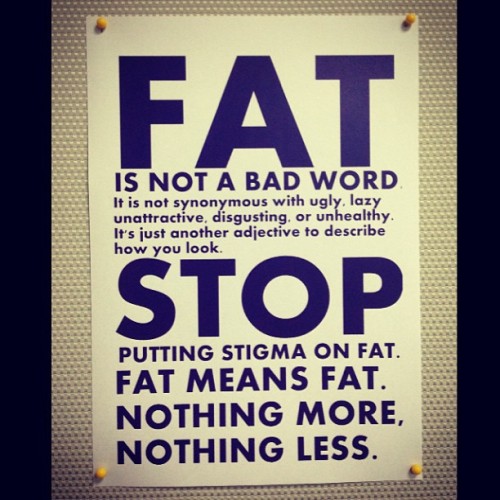
Phat resources on Fat Shaming, Body Positivity and Self Acceptance.


A lot of people have messaged me to ask questions about my post on fat shaming and body image to ask questions. There are loads of resources out there. I'm going to list a few here. :) 

What it's all about- wikipedia

If you have tumblr the body positive tag is always fun- http://www.tumblr.com/tagged/bodypositive

And here are some other tumblrs you might like-
Fat Art
Body Positivity
Fat Grrrl Activism
Body Posi
Redefining Body Image Post
Big Fat Feminist
It Gets Fatter (For fat queer people of colour)  


If you want things on facebook-  
Body Positive Image Campaign

For twitter- 
Fat Positive Tag
Body Positive Tag
Fat Positive Hulk

Google image that shit. 


Asortment of websites and blogs-
Body Shaming Article 
http://fiercefatties.com/
Fat Liberation Manifesto 
Recognising body shaming 
Top 50 Self Acceptance blogs
Fat Feminism
The most highly rated fat acceptance books
Fat positive youtube videos
Ways to deal with body shaming 
On raunch culture and body image 


I'm happy to answer questions etc, but a lot of answers will be found in these resources! :)