Showing posts with label rights. Show all posts

Monday, 23 June 2014

Being a care leaver, being a survivor.


What does it mean to be a care leaver? 
In policy terms it means a relevant child or former relevant child who has been under the care of their local authority as a young person. For the purposes of our everyday lives I will discuss what being a care leaver means on a practical, emotional level and what it means within society. These discussions may not be confined or limited to purely legal definitions depicted in government policy.

The experience(s) of young people in care is one of the most important  measurements of society’s values.We need to talk about our experiences in care, because they shape who we are after care. We are taught how and where we fit into society whilst in care. But we also learn about how society functions in relation to us because being in care means you are very aware of how the state treats some of its most vulnerable citizens. The entire country’s ideas and values are built around the government and politics of the time (whether people agree or disagree with them is less important than the fact they exist.) And because so much of our interactions with the local government are taken up by initiatives and new schemes (does anyone remember free laptops?), we understand which parts of our lives society sees as important and which parts it chooses to forget or ignore.

 Abuse, representation and reality
For example of young people in care being yardsticks of values I will discuss a time paedophilia and child abuse were less discussed, engaged with and investigated. An instance of this is the widely discussed case of Jimmy Savile, whose celebrity status and power gained him entry to the homes and lives of vulnerable young people in care.  In the 2012 documentary produced by the BBC entitled ‘Jimmy Savile What the BBC knew’ the  investigators spoke with people who were in care and abused by (or witnessed abuse by) Savile.  Young women were often taken out in Savile’s car and didn’t realise that his actions were abuse, some even believed them to be romantic. In a lot of cases it seems safe to say that the lack education on relationships that these young women received contributed to them believing the interactions they had were healthy, and the abuse they endured was a ‘trade off’ for escape from their homes and for getting some attention that made them feel important. This, along with the workers in the homes being in awe of Savile, and the Police dismissing the young people's reports meant that many of these young people, now middle aged and older have never spoken about their experiences.

So celebrity culture, the police and the care system created a free pass for Savile to abuse young women. 

Obviously some things have changed now. There is policy in place by for both the police and local authorities that should prevent this situation from happening. It is worth noting that this policy is often overlooked, or ignored by the police in situations relating to rape. Sometimes those who work with care leavers and young people in care don't get given the practical skills to put the policy into practice. This isn't the fault of those people, but rather a result of policy being written with lots of jargon and little understanding of how we live our lives.  Thus we see that the power dynamics of young people in care (with little or no power and understanding of the love and care they're entitled to) and adults with power over young people means that abuse occurs often. And just as often is goes unrecognised. 

Most recently there was the representation of (again sexual) abuse in the  Channel 4 drama The Unloved, this time they showed a young women being abused by a member of staff. The media often uses young people in care as a story, they sensationalise our experiences and turn us into statistics to scare their readers, but the media is often silent on other forms of abuse and the rest of the difficulties that face young people in care and care leavers.

Why abuse. why now?
I’ve had many interactions with other care leavers, at special events, and just personal chats and what seems most common is the widespread experience of abuse, before, during and after they have been taken into and left care. Obviously sexual abuse is important, but I’d like to define a few other kinds and open discussion about one. Physical abuse is  violence and physical harm, neglect is failing to meet a persons care needs, emotional abuse is bullying a person verbally, psychological abuse is more commonly understood as ‘mind games’. Abusers can be people in authority or our peers, it can happen at any point and all abuse is wrong.

 Most of the people in care I have spoken to and all of the care leavers I have gotten to know (and myself) have experienced at least one of these forms of abuse, usually more. I’ve never attended an event for care leavers that didn't turn into those present talking about their horrible experiences. Drunken foster parents, possessions stolen, or kept, physical harm, blame, lies told to social workers. I think one of the most important things I can say is- I believe them all. Care leavers and young people in care are so often not believed, so often people tell us that we ‘must’ have done something to provoke abuse towards us, but abuse is always the choice of the person committing it. We are not responsible for their actions. Because of the poor resources and structures that aren't effective we often have to work very hard to keep ourselves safe. That may be one of the reasons why so often care leavers live with a fight or flight response. We have strange habits, we may appear unusually protective of our possessions or unusually relaxed about them.We may get very upset when certain topics are mentioned, or seem very detached when we talk about topics that other people think are sensitive. We might feel scared that our homes and our things are going to be taken from us, this isn't because we're unnecessarily paranoid, but because we have been taught that this is what we deserve and should expect.

 Our experiences of abuse are real, they are difficult to process and we carry them with us as care leavers absolutely every single day. This is not to say we are weak, or we can’t let go of the past, or we can’t form healthy relationships, but that we have a very different experience to our peers who have not been in care. Of course other people can encounter all the forms of abuse I have listed above, so what’s the difference? 

 What's new?
Being 'looked after' by the state/government means we are automatically at the mercy of whoever is in power. And the people in power may change and have different ideas about how to run the country, and how much funding the local authority(/ies) should have. In fact, from what I have seen, funding problems are more consistent than any scheme or project. Funding is reallocated or the terms of receiving it are changed, it's suspended, lessened or replaced with alternatives but this usually means the same thing- less money for those who need it. This is the same for all who need the help of the government, from people's benefits to hospitals to libraries. Very often care leavers are seen as an unnecessary expense.

I don’t want care leavers to feel oppressed or like they have to put up with endless suffering, but I feel it’s really important that we name the harm and sadness caused to our lives by the ever disappearing funding and the bureaucracy we encounter in just trying to live our lives. I think we should call it 'administrative neglect'. Our needs as care leavers are being ignored by the administration the people high up who run the government.

 This is not about the people who have cared for us, or social workers, it’s not a personal problem, it’s a problem with the system. It's a problem with the people who decide that our local communities can cope with millions of pounds less. The problem becomes real when the local government decide us, care leavers, are the best place to start cutting that money from.  This is offensive and unfair because the person deciding to cut funding has never lived in a kids home, has never run away from foster parents, doesn’t understand that university funding is sometimes the only reason some of us consider university. They are not qualified to make decisions about our lives, (but, just like the examples from before) because they hold power over us they are able to make choices about our lives that negatively effect us.

Why does it matter?
There’s a very important reason for us to recognise the failures and abuses that have happened; they impact our quality of life and our mental health, our aspirations, our physical health, our living conditions, our opportunities and self-esteem. Without understanding how these problems have changed our lives we can't begin to think about recovery. Much of the time care leavers attempt to go on with their lives like other people do, we get jobs, have families, or form relationships, but there’s always something that seems different. Often these walls of a life that we’ve built for ourselves fall down, and we feel unable to perform the average tasks to keep our lives flowing normally. It can be as simple as being scared to open letter, or as complicated as being scared to interact with the state via the NHS and not seeking adequate medical help. When this happens, we blame ourselves. Self-blame can tear lives apart, can make us believe that we didn’t try hard enough, or that our interactions with drugs, or with the judicial system are just incidents we’ve brought on ourselves. The reason we need to recognise administrative neglect is that these cuts often mean that there's not enough resources to teach us how keep our lives going, and how to mend them when they break. If that is the case, then the system of one person holding power over another is harming people. If, like I said earlier, young people in care and care leavers are the yardstick by which we can measure the values of society then what does that say about those values? It often seems like the media who were so interested in reporting about how many of us are 'victims' of sexual abuse don't want to report when powerful people in our country make cuts that make our lives worse.

So where does this leave us? 
Well often care leavers will find solace in another community, it might be friends we’ve met through college or university, it might be a community based around drugs, or other young parents, or a political community. I’m not here to say that any of those are wrong, we do what we need to do to build ourselves a family, to make decisions for ourselves, to get support.

One of my communities is feminism, (women’s rights) which is tied up a lot in children’s rights too. In  feminist discussions people who have experienced abuse aren’t called ‘victims’, they’re called survivors. If there’s one thing I would encourage all care leavers to do it is this- the next time you think about how you have been treated, or any abuse received and begin to feel weak remind yourself that being stood where you are now means that you survived it. You have overcome it. And though there might be nights when you feel anxious or scared, though you’re not always managing to juggle adult life just you, getting out of bed this morning (or staying in bed for a rest) means that you are surviving.

I don’t believe that there will be big changes to the government structure that will allow young people and care leavers to exist free from administrative neglect. But I do believe that the idea of a society where people in care are treasured and not condemned to suffering through administrative neglect is an idea worth hanging on to. After all, we’re all allowed to hope, right? Until the point when this is a reality I’ll stand tall with all of the other people who have suffered abuse in care and as care leavers and say- I’m not a care leaver, I’m a care survivor. Because you can take the kid out of care, you can't take the care system out of the kid, and if I'm going to carry so many experiences with me, I want to do it as someone who is still standing, I want to do it as a survivor.


Saturday, 24 August 2013

To Russia with Love

(If you wish to add your name to this letter please email pipgeorgeson@gmail.com. Please put the subject of your email as 'Russia Letter' and include your name as you would like it to appear in the body of your email.)

We, the undersigned, wish to extend our steadfast solidarity to those suffering under and fighting against the oppressive 'homosexual propaganda' law in Russia. As a community we believe the radical history of our movement shows that change is possible and we remain dedicated to working towards this change.

Many media outlets have reported that the LGBT community is simply concerned about this law as a threat to our athletes. Whilst we do worry for all those travelling to Russia, this is not the whole story. We feel this coverage provides only a superficial insight into our concerns and neglects to recognise our other alignment. Our alignment is to those trodden on by these laws everyday, those who live with the marginalisation and fear bred and normalised by this legislation. It is you, our LGBT siblings in Russia to whom we send our love and support.

To Putin, to each of the four hundred and thirty six individuals who voted through this law we say; your deeds will not be forgotten. The world is watching as you legitimise the oppression of millions of your citizens. For individuals such as yourself who occupy a privileged position in society, you cannot understand the strength found in shared struggle. The link between LGBT people will not be stopped by legislative boundaries, borders or language barriers. You cannot hope to contain it. This link will exist until true liberation of all oppressed groups is achieved.

When you make freedom to talk about identity illegal, when you arrest our siblings for their trans* status and sexuality; we see the nature of the society you wish to build. A society in which the suffering of LGBT people is deepened and celebrated. A society that does not allow people to fight for liberation. You wish to maintain a world where neo-Nazis can beat a woman for being transgender without arrest but Pride marches are attacked by police. A society where young people are 'protected' from healthy and inclusive discussions about sexuality and gender, and so are taught to supress and despise their own. It is a society where 'traditional family values' is code for regressive attacks on groups of your choosing. We find your actions vile and unjust. And we refuse to stay silent. When you attack any of the LGBT community, you attack us all. When you deny people the right to fight for their own liberation you only strengthen the empathy shown to them by people who share their struggle, around the world.

To our LGBT siblings in Russia; know that when you march against injustice the spirit of our movement is carried with you. When you are erased by bigotry know that we see you. Within each continent, every country, city, town, there are LGBT people who struggle to fight against the particular discrimination of their government. We believe that we have more in common through this struggle than with those who run our countries.

Let us offer you our strength where yours may falter. Let us offer you our hands to help when yours are tied by institutional  homophobia and transphobia. Should you wish us to boycott the winter Olympics we will. If you want us to march in the streets we will. Should you wish us to publicise the atrocities visited upon you by the Russian government, to speak the names of those killed and detained, to keep their struggle alive; we shall.

Our message to you is simple- we see your struggle, we stand with you and we await your reply.

In solidarity,

В РОССИЮ С ЛЮБОВЬЮ Мы, нижеподписавшиеся, хотели бы выразить нашу непоколебимую солидарность с теми людьми, кто страдает от деспотического закона о запрете так называемой “пропаганды гомосексуализма” в России и борется с ним. Являясь единым сообществом, мы верим в то, что история нашего движения, наполненная событиями, радикально изменившими ход общей истории, показывает нам, что перемены возможны, и мы продолжим целенаправленно двигаться к этой цели. Многие средства массовой информации утверждали, что сообщество ЛГБТ волнуется по поводу этого закона лишь потому, что он представляет собой угрозу нашим атлетам. И хотя мы на самом деле беспокоимся за всех тех людей, которые приезжают в Россию в качестве туристов, это не полностью отражает ситуацию. Мы полагаем, что освещение событий именно в таком ключе является лишь поверхностным пониманием наших забот и игнорирует наши идеи объединения с такими же людьми, как мы, только притесняемые подобными законами ежедневно, живущими в условиях маргинализации и страха, порождаемого подобными законами, страха, который таким образом превращается в обыденность. Это вам, наши ЛГБТ- братья и сестры в России, передаем мы наш привет и выражаем поддержку. Путину и каждому из всех четырех сотен тридцати шести человек, которые проголосовали за этот закон, мы говорим: ваши поступки забыты не будут. Мир следит за тем, как вы легитимизируете угнетение миллионов ваших граждан. Являясь людьми, занимающими превилегированное положение в обществе, вы не сможете понять ту силу, которая возникает и объединяет нас в общей борьбе. Связи между ЛГБТ не будут прерваны законодательными барьерами, границами или языковыми препятствиями. Вы не сможете нас сдержать, как ни надейтесь. Эта связь не прервется до того момента, пока не станут по-настоящему свободными все угнетаемые люди. Когда вы даете себе свободу говорить о том, что какое-то самовосприятие является незаконным, когда арестовываете наших братьев и сестер за их транс-сознание и сексуальность, мы видим, какое на самом деле общество вы хотите построить. Общество, в котором страдания ЛГБТ становится еще более сильным и резонансным. Общество, которое не дает людям возможность бороться за свободу. Вы хотите жить в мире, в котором неонацисты могут избить женщину за то, что она трансгендер, и оставить их безнаказанными, а шествия ЛГБТ подавляются полицией. Общество, в котором дети “защищены” от трезвого и всестороннего разговора о вопросах сексуальности и пола, в котором их учат подавлять и прятать собственную сексуальность. Общество, в котором “традиционные семейные ценности” являются правилом, позволяющим совершать агрессивные нападки на группы людей по вашему собственному усмотрению. Мы считаем ваши действия подлыми и несправедливыми. Мы не будем молчать. Когда вы нападаете на какую-то группу ЛГБТ, вы выступаете против нас всех. Когда вы отказываете человеку в праве на борьбу за свою свободу, вы лишь увеличиваете чувство сопереживания со стороны людей, которые участвуют в такой же борьбе по всему миру. Нашим ЛГБТ-братьям и сестрам в России: помните, что когда вы выходите на улицу в борьбе против несправедливости, наше движение тоже не забывает о вас. Когда вас исключают из общества проявлениями нетерпимости, мы видим вас. На каждом континенте, в каждой стране, городе, селении есть ЛГБТ, которые борются против дискриминации со стороны властей. Мы верим, что у нас гораздо больше общего благодаря этой борьбе, чем у тех, кто руководит нашими странами. Хотим выразить нашу поддержку всем, кому её не хватает. Хотим подать руку всем, чьи собственные руки связаны узаконенной гомофобией и трансофобией. Если вы хотите, чтобы мы бойкотировали зимние Олимпийские игры, мы сделаем это. Если вы хотите, чтобы мы вышли на улицу, мы сделаем это. Если вы хотите, чтобы мы предали известности те зверства, которые совершает в отношении вас российская власть, предать гласности имена всех, кто был убит и брошен в тюрьму, чтобы поддержать их в этой борьбе, мы сделаем это. Мы хотим донести до вас простую мысль: мы видим вашу борьбу, мы рядом с вами и ждем вашего ответа. Выражая нашу солидарность,

Kashka

Jacques Gonseaux

Tom Mycock, Unite rep, Leicester

Matt T

Tom McCarthy

Mx Geo Leonard

Morgan Millicheap

Jenny Hacket

Sky Yarlett

Yolly Chegwidden, NUS LGBT Committee

Clare B

Dave Sherbert

Rhodri Roberts

Francesca Pirovano

Amy Addison Dunne

Dan Stone

Becca Dye

Jack

Dan Conama

Logan Lawson

Morgan Hale

Caroline Leneghan

Alex Louise Wheller

K. Pearse, Liberation Officer at Warwickshire College (Lemington) SU

Kier. A. Sinclair

Senora Nicola Skotudoodah

Lynn- D Fletcher

Lea Howard

Sarah Noble

Emily Rae Fowler

Andi Herring

Matthew S

Naomi B

Rachel Smith

Charley Hasted

K. Marsden

Josh Davies

Rhiannon Lowton

Anna Cat

Martyn Price

Rosie Huzzard NUS NEC, NCAFC NC and PCS DWP Sheffield Young Members Officer

Aaron Booth

Kaylan Hughes

Nick Fischer

Jo Smith

L. Webb

Dan Fahey (Committee for Workers' International)

Rob Young

Sarah Lynn

Lani Baird

Alison Stevenson

Liat Norris

Fran Cowling, NUS LGBT Committee

Shian Streadwick-Augustine-Cain

Elliott Marshall, LIV.FAST Network

Claire Hornby

Michael Stickland

Chua Zhong Xian

Rachel Ivens

Felicity Dowling

Codie Louise Austin

Stephen J. Wright

Matthew Smith

Osman Bhatti

Sarah K

Tina Rawr, Equal Rights

Alex Prestage

Nyssa Blakeley

Gareth Kirman

Kris Bailey

Emma-Jane Samworth

Amelia Bradley-Newby

Sean.C

Emma Pooka

Trish Clinton NUS LGBT Committee Bi* Rep

Aura Willow Hazel

Daria Hopwood

Tuesday, 20 August 2013

LGBT News in the last 7 days

So I'm trying out a few different ideas on here this week. One of them is a round-up of news on certain topics from the last seven days. Let me know what you think; do you like this format? Would you prefer more insight into the stories? Have I missed any news you think should be here? You can either contact me on facebook, comment on this blog or email me pipgeorgeson@gmail.com.

1. Section 28 Returns in Academies
It emerges this week that several academies have retained or adopted policy to 'ban the prommotion of homosexuality in classrooms' in the style of Section 28. The '80s called- they want their regressive legislation back.

2. Athletes Kiss in Protest to Russia's Anti-LGBT Law
Yeah, fuck you, Putin.

3. People in Northern Ireland join activists around the world in protesting Russia's law

4. and the Miss World host quits over it, too.

5. Radio host thinks 'The Gays' and their insistence on human rights is oppressive.
I fully believe that with a bottle of this woman's tears, the rainbow flag and the right incantation; I could summon an army of Aggressive Homosexuals.

6. The Mysterious Case of Nikoli Alekseev
The facebook account of a prominent LGBT activist in Russia was vanished after some uncharacteristic statuses and some strange and worring pictures were posted on it.

7. (Massive trigger warning for transphobia and violence) A Russian transwoman is stripped and beaten in public.
Horrific story, horrific incident, beware that images are included in this article.

8. Queerfest in Canada
Looks pretty awesome. The article has a comment section at the bottom with one phobic contribution. Sigh.

9.Puerto Rico takes steps forward in LGBT inclusion
You Go Glen CoCo.

10. Gay Porn company to give all profits to help the LGBT community
Yay!

Saturday, 13 April 2013

My experience of Steve Hedley and a message to the British Left.

*Disclaimer/TW*
Triggering issues including mental illness, domestic violence, victim blaming and body elitism are discussed in the following post.

As most trade union/left activists in the country know, there has recently been an incident regarding domestic abuse. On International Women's Day 2013 Caroline Leneghan (RMT- Rail, Maritime and Transport Workers union) made public an account of how her ex-partner Steve Hedley (Assistant General Secretary of RMT) abused her physically and mentally during their relationship. Leneghan's blog can be found here and contains pictures of her injuries that some readers might find upsetting. In her blog she detailed how when she took her complaint to RMT & she detailed several ways in which RMT tried to disregard her allegation
  1. The investigator attempted to make a link between her mental illness and the abuse she suffered.
  2. She was asked about her personal history.
  3. She was asked how someone of Hedley's build with a history of boxing didn't hurt her more.
RMT then cleared Hedley and on the back of the investigator's attempt to blame Leneghan's mental illness he wrote a statement which you can read here.

A few weeks before this Leneghan published her account of the abuse she suffered at the hands of Hedley, I got into an online argument with him. Firstly during the argument he stated that I 'couldn't handle the topic' attempting to convince me and others that my point was non other than a product of me being to delicate for the discussion.


His tone with anyone who contributed to that discussion was vile, but to me in particular. He told me that 'in the real world' people argued and alleged that I was a 'middle class student' who would soon be 'sacking the workers' (presumably with my English degree from Edge Hill). When I affirmed that I was indeed working class, a council tenant, a care leaver and had extensive experience in the 'real world' he then shifted his attack to my looks. 


Hedley's attempt to silence me by telling me I was middle class, then telling me I was ugly then telling me I needed to 'find myself a partner of some kind'  made me feel like my part in the debate was completely dictated by my gender and by my age. A well paid middle aged man in the high ranks of the RMT being misogynistic, ableist, and attempting to intimidate a young woman isn't as serious his violence to Leneghan, and I wouldn't want anyone to think that for a second. What is similar, however was the way in which Hedley reacted. 

First he attacked me and then when I fought back he told me that my mental health was the problem and that I needed to 'seek some help', he also went to look on my profile. Finally when I refused to allow him to bully me publicly he told me that I was playing the victim and that I had been attacking him by swearing in my comments.
 First he physically attacked Leneghan and then when she sought help in his statement he told the world that her mental health was to blame and he hoped she would get the help she needed and he implied he had been the victim. 

There's a pattern emerging, isn't there? I spoke to someone who worked with domestic violence victims and they told me that abusers tend to use one set of behaviours repeatedly to disempower the people they wish to hurt. Hedley's attack on my mental health and his pointing to Caroline Leneghan's as the problem isn't a coincidence, it's a tactic used to make onlookers (and the victim) question the validity of their opinion. 

Unfortunately I've encountered many men that attempt to silence me with bullying tactics and many of them in the Left, I've seen first hand in the SWP what not listening to women and survivors can do. It's poisonous. So I have a message to the British Left;

 women will not be silenced any more and your attempt to disregard the abuse we suffer will result in your cause being weaker. No longer can you hide misogyny or rape apologism behind a veil of doing the best for the party or the cause. No longer can you appropriate the women's struggle with tokenism to strengthen your appearance whilst simultaneously pushing silence upon us. 
There will be no radical left without women's liberation and no women's liberation with victim blaming and rape apologism. 

Wednesday, 13 February 2013

On same sex marriage


Dear Rosie Cooper, 
My name is Kashka, I sit on the committee of Merseyside LGBT Students'
Network and I'm also the President of Edge Hill's LGBT+ Society. I
originally planned to contact you a few weeks ago to invite you to
partake in a debate we're holding for LGBT History Month entitled 'Is
Equal Marriage the final battle for LGBT liberation'.
 
After the vote in parliament on equal marriage, and you decision to
vote against it, you can understand why I am now not inviting you to
speak. I don't believe there are words to explain to you just how
poisonous and destructive your actions have been. The decision to vote
against granting equal rights to same sex couples was shared by bigots
from the conservative party and UKIP. 
As an individual I am hurt, as an activist I am scared and as someone
who has lived in West Lancashire for the majority of my life and been
under the care of the local authority; I am horrified. I'm horrified
that people around the country will see your name on the list of shame
(so it's entitled in an online blog) and think that your vote reflect
the opinions of those in the area. I'm horrified that the local young
people, who are too scared to come out as gay, bisexual, lesbian or
trans* will see that their local government sees them as less than
their heterosexual peers and this will feed internalised homophobia.  
You have failed to represent these young people.
You have failed to represent me.
You have failed to represent the any of the LGBT people in the
district. 
You have failed. 
You have hidden behind 'morals' without thinking of consequence,
without thinking of representation and because of that; you have failed
yourself.
I will eternally remember that the person 'representing' me in
parliament believes that I am not entitled to marry. I had previously
voted Labour because I saw them as a progressive party. Maybe they
still are and if you consider them to be; maybe you should consider
leaving. 
The damage you have done is permanent and there's nothing
Christian about it.  
 Yours, a former Labour supporter,
 Kashka Georgeson

Monday, 11 February 2013

Phat resources on Fat Shaming, Body Positivity and Self Acceptance.


A lot of people have messaged me to ask questions about my post on fat shaming and body image to ask questions. There are loads of resources out there. I'm going to list a few here. :) 

What it's all about- wikipedia

If you have tumblr the body positive tag is always fun- http://www.tumblr.com/tagged/bodypositive

And here are some other tumblrs you might like-
Fat Art
Body Positivity
Fat Grrrl Activism
Body Posi
Redefining Body Image Post
Big Fat Feminist
It Gets Fatter (For fat queer people of colour)  


If you want things on facebook-  
Body Positive Image Campaign

For twitter- 
Fat Positive Tag
Body Positive Tag
Fat Positive Hulk

Google image that shit. 


Asortment of websites and blogs-
Body Shaming Article 
http://fiercefatties.com/
Fat Liberation Manifesto 
Recognising body shaming 
Top 50 Self Acceptance blogs
Fat Feminism
The most highly rated fat acceptance books
Fat positive youtube videos
Ways to deal with body shaming 
On raunch culture and body image 


I'm happy to answer questions etc, but a lot of answers will be found in these resources! :)


Friday, 8 February 2013

Why I'm not running in my union elections


Firstly, I'd like to thank everyone who encouraged me to run in the election & everyone who has supported me in the last few months, those friends who have ferried me to hospital appointments and given their time to listen to me. Partners, who have emotionally supported me & helped remind me who I am at times when I lost sight of that. Comrades and activists up and down the country who inspire me and remind me why we do what we do. I feel privileged to have you all in my life.

I’ve made no secret about how much of a difficult time I've had with Edge Hill Students' Union over the past couple of years. From the destruction of the student council, to poisonous nepotism and the active discouragement of student participation from certain sabs, I've found engaging with my union continually disheartening. I felt consistently unrepresented, as LGBT+, as a woman, as a disabled student. I felt these groups were ignored. After an interaction with a sab who stated that they didn't feel they represented these groups in their first year in their role but didn't feel they 'had time' to represent these groups in their second year, I was horrified, I was dismissed.

I decided something had to change so became involved in my union in multiple ways: I didn't want to be an armchair activist. I took a leading role in rebuilding the non-existent LGBT+ Society, we created a community that was formerly invisible on campus. We did amazing things like being quoted in the universities' anti-discrimination policy, getting our safe space policy union-wide, having Peter Tatchell talk on campus, holding safe space support, campaign, social and educational meetings for students every week.

 We took Edge Hill Students to their first NUS LGBT Conference, we joined forces with the three Liverpool Universities to form Merseyside LGBT Students' Network. We networked with LGBT activists up and down the country and through MLSN I saw what a union that cares about *everyone* looks like. I lead LGBT students on their first demo, we built relationships with LGBT staff & got a gender neutral toilets motion passed at directorate and then held a direct action when facilities management decided to ignore the motion. I hope after leaving Edge Hill that even if for a short time, the work we did has improved life for LGBT students on campus. In this time I learnt just how powerful the passion of a few people can be.

But this wasn't written to brag about what we achieved. The the primary reason I decided during my second year to run for vice president of arts and sciences was because of the way, despite the positive change I helped instigate on campus, some sabs who should have been encouraging and supporting this change, were still dismissive. And there was a lot of work left to do.

In my time attempting to be proactive on campus I tolerated sexist jokes, I tolerated the condescending looks, tones and emails. I even tolerated an incident when three male (cis/straight) men laughed at a transphobic postcard we received during a post secrets campaign for International Day Against Homophobia and Transphobia, because I felt ignorance was their problem. As a result of this me and other students in the society arranged and delivered an educational session on trans* oppression. Of the two remaining staff who first laughed at the joke, the one who turned up made a joke about me attempting to turn him into a homosexual.

I spoke about my running for election openly. I was planning on slating with Kate Jackson, a brilliant woman who is one of our best allies on campus. I received a mixed reaction from union sabs from encouragement, to amusement and even active verbal discouragement from one person! I had fellow students delete me from social networking website because they were running, too. I had other candidates interrogate me about Kate Jackson’s campaign every time they saw me! But, despite the election stress I was determined that minority group students should no longer be made to feel unimportant, I built up good links with the Islam Society and the Christian Union, I attended Feminist Society meetings, and I had meetings with the universities’ head of Equality and Diversity. I decided that with enough energy and passion students on a grassroots level could instigate change themselves. I had decided my slogan, my campaign colours, and my manifesto. So what changed? Well…me.

A fair amount of people on campus know about the fact I’m disabled. I’ve made sure LGBT+ Society has had a regular disabled caucus and that it’s accessible to people with a range of disabilities. Being out about being disabled, for me, is harder than being out about my sexuality. People get used to the fact you’re not straight, but that you’re disabled? Completely different. And there have been huge barriers in participating with the union because of my disability. I planned to change them, I planned to do for disabled students what we had done for LGBT students, and to put disabled students at the center of that change.

So now, instead of talking about what’s wrong with the behaviour of some individuals in the union, I’m going to talk about what’s wrong with me. I recently found out that the medication I’m on which slightly improved my eyes, has stopped working. It’s truly heart-breaking to find out that medicine that has severe symptoms (weight gain, energy loss etc) on everyday life isn’t doing what it should. My eyes are slowly getting worse and because of the symptoms, my hypothyroidism is getting worse. And because of the nature of hypothyroidism my bouts of depression and anxiety are getting worse.

Yes, there are still significant problems with the way some members of union staff feel entitled to treat serious issues surrounding ability, gender and sexuality. But I’ve had to take the decision to step away from the union this year in order to allow myself time to read, time to attend hospital every other week and time to spend with important people in my life. Coz, guys, what is scarier to me than allowing idiots to go on behaving like idiots; is not knowing if I’m going to lose my vision. If you’ve met me, which I’m presuming you have as you’re reading this: you know I care, a lot. And until I know whether or not I will be losing my sight I’m going to direct some of that care towards myself and the important (and often neglected) people in my life. I’m tired, increasingly depressed and I don’t have the energy to keep banging my head against the brick wall of other peoples’ ignorance. I have plenty of other battles and I’m not just politically active on campus, honestly, with the behaviour I’ve seen displayed I feel those individuals need positive change more than I do.

For those of you whose health allows you to run in this campaign: good luck. There are some amazing candidates who actually care, I should know, I was meant to have the privilege of running alongside one. 

Thanks for reading, if you have read all this! And thank you to all the amazing student LGBT, Women's, Disabled activists who remind me that there are people who are fighting for change. I'm going to miss not seeing (pun intended) you as often as I'm used to! 

Monday, 28 January 2013

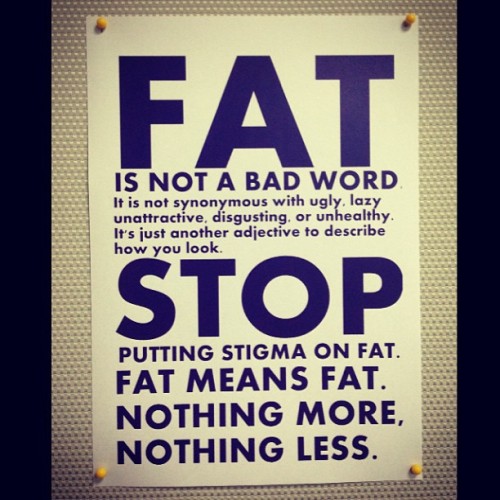
Whose fat is it anyway?

*Disclaimer: this blog applies to me and is applicable to my experience. I certainly don't speak for all women, let alone all overweight women.*

I have something I need to say, and it's not pretty. It's not sexy either. It's about fat. And not just any fat. my fat. I'm not sure how much and how emphatically I can stress this to you, dear reader; I don't consider my fat to make me an inferior person. And I never will. Rather than recount the long and complex journey I've taken with my body image over the years, or discuss the feminist issues surrounding fat, I'm just going to lay down some rules. If you struggle to shrug off the prescribed norms surrounding bodies and fat that fine. But here are some simple rules you can follow for interacting with this fat person:

1. If you get the urge to inform me I'm fat: suppress it. (This one goes out to the men in clubs, the girls from high school and all the other people who feel it's hilarious to tell me I'm fat). It might come as a surprise to you but I actually know I'm fat. Weirdly enough, I can see myself. I don't need you to inform me. Unless you have some deep seated issues relating to your self esteem & you think will benefit from putting me down: I don't understand why you'd want to take time out of your life to tell me.

2. Please don't presume you know why I'm fat. As it happens I have an illness relating to my metabolism which causes me to gain weight. But, even if this wasn't the case, I don't want your diet advice. I don't want your exercise advice. I don't want to join in with your weight loss challenge and no, dear lord, no, I don't want to hear about how your Nan/ Mum/Aunty's Dog lost weight. Strangely enough I'm not overweight because I'm not intelligent enough to google diets.

3. Please don't body shame me. Body shaming for me is really complex, but basically: I'd prefer it if all your comments about my body were kept to a minimum. A good minimum is silence. if I want your opinion, I'll ask for it. I don't need you to tell me I've put on or lost weight. I certainly don't need you to say 'Minute of the lips lifetime on the hips' whilst I'm eating. I don't need your humiliation. Thanks. If you choose to believe the hype society makes about all fat people being lazy and generally awful human beings and feel compelled so strongly to save me from yourself: why not do it privately? And then I can privately tell you to go fuck yourself. :)

4. Don't presume that *any* weight loss is good. See, society has constructed a reality where fat=bad. So when you see that I've lost a little bit of weight, you want to tell me 'Hey, well done, you're not as physically repulsive as you used to be'. The problem here though, is that my weight is a symptom of a disability. Sometimes I lose weight because I'm ill, or cant afford to feed myself properly or can't afford a lot of heating or because the illness that my weight relates to is easing up slightly. But all those variables are temporary and so inevitably I'll re-gain that weight. If you notice this, it is most certainly not your place to be disappointed. I'm not asking you to keep quiet because I'm arsey, but because it's not good for my mental health for you to congratulate me on poverty weight loss and the pressure to maintain a completely unsustainable weight loss isn't helpful either. 

5. Please don't presume that I require or will welcome your approval. I once received a phone call off a family member who thought they would ring me up to remind me that fat girls can be attractive too! Listen, purrr-lease; if you have a problem with confusing weight and attractiveness, that's your business, baby. Don't make it mine. I don't hold the same values as you or see the world through the same lens, I don't need you to find me attractive *despite* my clearly disgusting and horrific disability. Really. Also in relation to this: don't presume that people you deem unattractive don't ever have sex or that people don't ever find them attractive. You're sorely mistaken.  


What I think happened is that somewhere down the line fat got communal. And now people who have no qualification other than being slimmer than me, and not suffering from the same condition I do, now feel like it is there place to save me from my gluttonous ways. For a long time I allowed myself to be taken in by this culture that thrives on insecurity on punishment and not help, on laughing and not caring. But my fat doesn't belong to this culture, it doesn't belong to well meaning friends, it doesn't belong to drunk men in pubs or anyone else:

it belongs to me. And you should probably respect that.

Sunday, 15 April 2012

Sara Malm’s article on strikes is disgraceful, selfish and quite frankly passé.


There are some moments that make you want to hang your head in shame. The morning of Friday the 13th is one of them and no, it’s not because my boiler broke, I lost my keys or walked into a glass door. This time I’m not hanging my head in shame because I’m ashamed for myself, but because I’m ashamed for my generation.  This time, I’m ashamed because I’ve read Sara Malm’s article and her regressive naïve attempt at trivialising the historical role of unions and strikes.

Apparently Sara wants to be a journalist to ‘shape the news’. The less said about what kind of shape she’s working towards the better. I can only assume (or hope) that the article was some ill-orchestrated attempt to jumpstart your career as a journalist, Sara. Think about it, you could be the Queen of Controversy. People would read your over simplified analogies every day to shock and disgust themselves over their cornflakes. You’d never have to work an ‘entry level’ job again.

And that’s the crux of the matter really isn’t it? You know how difficult it can be working your way up. You know that the strain put on people by the targets of management causes resentment. How unfair. Almost as unfair as, say, having worked hard to become a teacher, dedicated most of your life to educating the next generation just to be told that’s you’re actually disposable, a resource. That your pension and jobs and working conditions can be taken from you at any time. Make no mistake about this; striking is a clear way of saying ‘No’.

‘No’ we won’t work half our lives and then live in poverty after retirement because some public school boys say so.
You mention you jobs in this ill-informed attempt at political commentary. And I expect that during these jobs you worked a set amount of hours? For a set wage? That you worked less than seven days a week? And you didn’t start working at the age of four? Interesting how you write a scathing (and let’s face it, weak) denouncement  of unions, as you work a 9-5 job with your basic human rights intact. And yes, Sara, you have unions, strikes and ‘foot stomping’ to thank for this.

We’re all well aware of the practical difficulties facing parents when teacher strike. There’s a reason most do it without writing adjective ridden articles and angry letters; they understand it is necessary. A way of ensuring that the future generation will get a wage they can live on, will get to retire and will be able to survive when they do. If our teachers, hospital staff, social workers and civil servants allow their pensions, jobs and rights to be taken away from them, how will they look their grandchildren in the eye when asked ‘What did you do?’
It is a temporary inconvenience with long term implications. The unions are not sulking, throwing a tantrum or screaming in the aisle of a supermarket. They are reminding a blasé government that those pieces of paper they are holding have real life consequences, apply to real people and these people have worked hard to have the wage, pension and right that they have. Why would they silently let them be taken? Hardly the same as pulling a sickie because you had one too many glasses of wine the night before, is it now, Sara?